The Digital Twin
Scout can already do your work - on your machine, across your repos, into your mail and calendar. Files, code, git, whatever the job needs. What it can't do is any of it as you: decide which of two priorities wins, hold back the thing you'd check first, shift its writing between your manager and a partner team.
So every session starts with you re-explaining yourself. Work IQ closes some of that by inference, but you can't read what it inferred, correct it, or take it anywhere.
Today you write it down as files you own, and get a skill that works the way you do.
Objectives
Build a digital twin - a SKILL.md and a references/ folder that hold how you work - then build something on top of it that runs on your machine. Scout writes the first version from your own mail, calendar, and Teams; you correct it, then point it at a real job.
| File | Holds |
|---|---|
persona.md | Who you are and how you decide - who you serve, what wins when priorities collide, what you check before committing |
voice.md | How you write, plus a few of your own messages kept verbatim, so output sounds like you |
By the end, you should have:
- A twin that works like you - it drafts in your voice and takes the positions you'd take, and you've corrected what it got wrong.
- Something built on it that runs - a brief, a catch-up, a dashboard, an MCP server: one real thing that uses the twin and that you'd open again tomorrow.
Setup
Check Scout is signed in and Work IQ is live. Ask "what's on my calendar tomorrow?" - a real answer means you're ready. If not, grab a coach.
1 · Download your twin
🧬Your twinThe skill, plus one worked example built on it. Unzip and import the folder.Download .zip →2 · Import it
Unzip the download. You'll get a folder called
my-twin.In Scout, open Extensions → Import and drag in the folder.
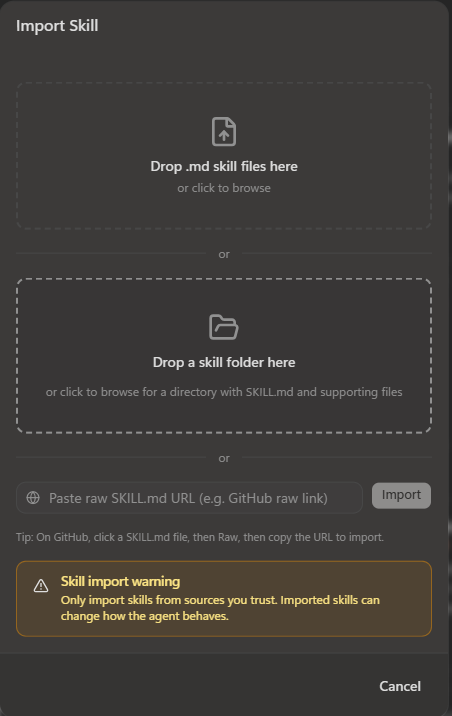
Start a new session - skills load when a session begins.
Import the folder, not the file
SKILL.md isn't the whole skill. Templates and a worked example sit beside it, and dragging the file alone leaves them behind.
3 · Build it
Start a new session and type in the following prompt:
Set up my twin.Your twin tells you what it's about to read and waits for a yes, then reads your sent mail, Teams messages, and about a month of calendar. Its access is read-only - it only sees what you can already see, and its files stay on your machine. It drafts two files with the evidence under each line, tagged by how directly it knows:
my-twin/
  references/
    persona.md      ← who you are and how you work
    voice.md        ← how you write
    setup.md        ← how far setup got
It finishes by triaging what actually landed in your mail and Teams, so you leave setup having watched it work.
Build
Your twin works, but it's generic - built from what your work proves, which isn't the same as what you'd say about yourself. Do a quick correction pass, then get to the main event: building something on it.
Keep it yours. You each build your own twin on your real mail and rules. When you compare with your table, share the prompt that worked, not your mailbox - a prompt carries none of your inbox with it.
Quick-correct your twin (~15 min)
Your twin's first read of you is close, not right. Do one short pass, then get building - you'll keep fixing it as you go.
- Ask it something real - something like "using my twin, what should I do about [the thing I've been putting off]?" Lead with the twin's name; a generic answer usually means Scout didn't call it.
- Find what's off. When an answer isn't yours, ask which rule made it say that, or ask to see your persona.
- Fix two or three lines, then move on. Tell it what to change in your own words, then ask your question again to see if the answer moves. A good line changes what the twin does - a name, a date, a hard no.
Prompts are examples, not scripts
Say it however you'd naturally say it - the twin understands paraphrase.
More things to try, and what the persona tags mean
| Ask something like | You get |
|---|---|
| "Triage what landed today." | Mail and Teams sorted into needs-me, blocked, handled and noise, with drafts |
| "Draft a reply to [a real thread]." | Something you could send, in your voice |
| "What am I forgetting this week?" | Your calendar and your commitments read together |
| "What don't you know about how I work?" | Its own gaps, named - it's read a month of your work |
Your persona's sections are each tagged by how directly the twin knows them:
[observed] | Found in your mail, chats or calendar, and the twin can quote it |
[inferred] | A reasonable read, but you never said it outright |
[needs you] | Nothing in your work reached this, so it wrote a starting point |
[inferred] and [needs you] are likeliest to be wrong, so they're a good place to look first.
Give it a name you'll actually use. Say "rename my twin to Clippy", then start a new session so Scout picks it up.
Pick a direction
Now build something that uses the twin - take one as it is, combine two, or build something specific to how you work.
🔌 The MCP option uses an existing server
Browse Microsoft's MCP server catalog and connect one, rather than building a tool of your own.
Build in layers
Get it running end to end, then add one thing at a time:
- Smallest version - "Build the smallest version that runs end to end."
- Your rules - "Use my persona and voice so it takes a position and sounds like me."
- One addition - "That works. Now add [one thing]."
- A bound - "Cap this at [N days] and [N items] per run."
You approve before anything goes out
Keep the last step yours. Whatever you build should draft, show you who it's addressed to and what it says, then wait for a yes.
After today
This is a starting point, not the finish line. In one session, alongside a table learning the same thing, you got a twin working and built one real thing on top of it - and practiced the skill that matters: describing what you want, watching Scout build it, and correcting from there.
What you made won't change the world, and it doesn't need to. The twin is yours to keep - persona.md and voice.md are plain text, so they move to another altitude unchanged - and whatever you built today, you can keep building tomorrow.