
Immersion Experience – Agents (Executives)
Explore how Microsoft 365 Copilot and Agent builder can help you address a real work-related challenge by designing a simple retrieval-based agent. This exercise will walk you through identifying an issue, breaking it down, exploring where AI might help, and then creating a conceptual agent to solve it.
You'll perform four tasks:
- Identify a work-related issue
- Break down the problem and explore where AI could help
- Use Researcher to uncover insights and solution ideas
- Conceptualize and mock up a retrieval-based agent in Agent builder
NOTE: Sample prompts are provided to help you get started—feel free to personalize them to fit your situation.
If you’d like help generating or refining prompts, try the Prompt Coach agent
, which can suggest, improve, and evaluate prompts so you get better results with Copilot.
Task 1: Identify a Work-Related Challenge
Start by thinking about a real issue you encounter in your role—something that slows you down or makes information harder to access. You can reflect individually, or use Copilot Chat as a partner to help generate ideas and identify a challenge where retrieving and organizing knowledge would make a difference.
To guide your thinking, consider:
- What’s working well today
- What’s not working well
- Where AI might be able to help
Steps:
Open a new browser tab and navigate to m365.cloud.microsoft/chat.
Ensure the Work mode tab is selected in Copilot Chat:

Sample Prompt:
textI’m researching common day-to-day issues I face at work, such as processes, collaboration, or time management. Look at recent conversations from [Teams chats, Outlook emails, or other collaboration tools] related to [your role focus]. Summarize the key issues or pain points mentioned in the last 6 months. Show the results in a table with: - Title: Short label for the issue - Description: Brief summary of the challenge - Frequency: How often it comes up (e.g., number of mentions)
Task 2: Break Down the Problem
Using Copilot Chat, take the challenge you identified in Task 1 and break it into smaller parts:
- What makes this issue difficult?
- Where does information get stuck or lost?
- Who is impacted most?
Try a sample prompt like this:
Break down the problem of [insert challenge]. Identify root causes, pain points, and which areas of work are most affected.TIP: Think about where retrieval of knowledge would save you time or help your team make faster decisions.
Task 3: Explore AI Solution Ideas with Researcher
Use the Researcher Agent to see how Copilot and agents could help. Focus on solutions that retrieve, organize, or summarize knowledge—not automate tasks.
Steps:
Open a new browser tab and navigate to m365.cloud.microsoft/chat.
In the Copilot Chat menu, expand Agents (if necessary) and select Researcher.
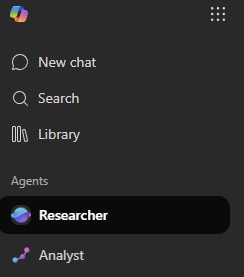
Sample Prompt (Researcher Agent):
textExplore possible AI solutions to address [insert problem]. Focus on retrieval-based approaches using Microsoft Copilot, Agent builder agents, or connected knowledge sources. Summarize three possible solution approaches, their benefits, and limitations.TIP: Look for opportunities where an agent could make knowledge easier to find, reuse, or share.
NOTE: Researcher may take 5–10 minutes (or more) to complete, depending on your request. Its responses are highly detailed, so while it’s working, try running the same prompt in Copilot Chat. Comparing the two outputs is a great way to see how each tool approaches the task.
Task 4: Build Your Agent
Now, take your insights and create a simple mock agent in Agent builder lite. Keep the focus on retrieval—your agent should help surface, organize, or summarize information.
Steps:
Start in Agent builder lite
Open your browser and navigate to m365.cloud.microsoft/chat.
Select New agent in the navigation pane to launch Agent builder.
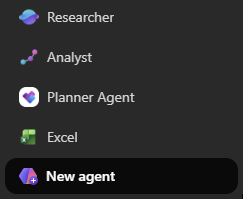
Define your Agent (Describe tab or Configure tab)
In the Describe the agent you want to create prompt box, draft your agent’s role. For example:
textYou’re a virtual assistant for our [project/team name]. Your role is to help with [key tasks]. Be concise, stay on-brand, and reference our shared resources when possible.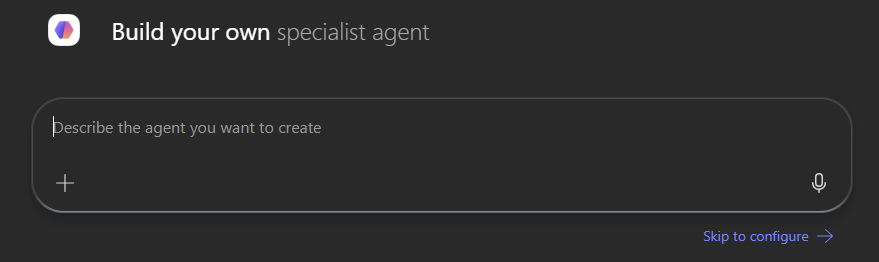
Customize your Agent
In the Configure tab, explore these options:
Add at least one knowledge source (e.g., a document saved to OneDrive/SharePoint or Your emails).
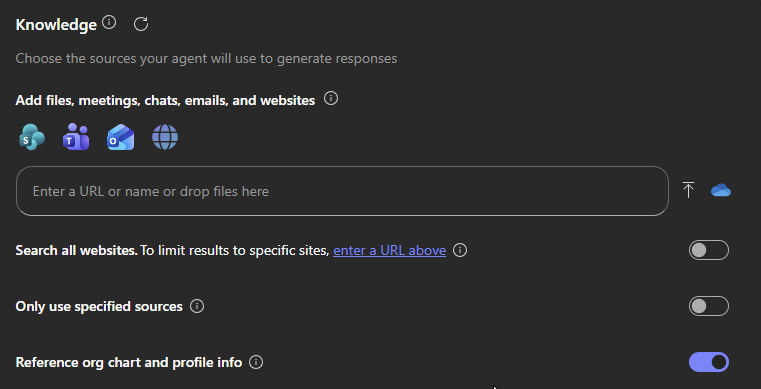
Define suggested prompts to help others get started with your agent
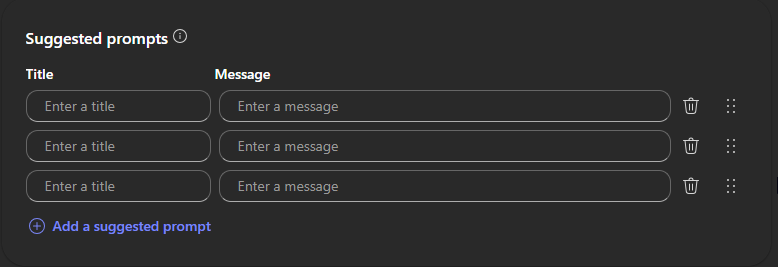
TIP: Suggested prompts help guide users on how to interact with your agent.
Test and Create
- Use the Preview feature (available in the right pane throughout the agent-building process) to try out your draft version of your agent and refine any issues.
- Once satisfied, select Create to publish the agent.
- Share your agent with others or open it for immediate use.
TIP: The goal isn’t to build a perfect agent today—it’s to explore how retrieval-focused agents can make knowledge easier to access in your daily work.